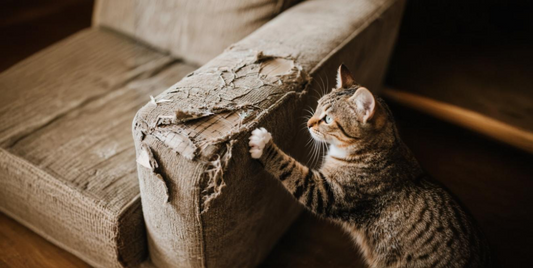
Walk into any pet store and you'll face an overwhelming decision: should you buy a vertical scratching post, a horizontal scratching pad, or both? The truth is, cats have strong individual preferences when it comes to scratching angles, and choosing the wrong type can mean your expensive scratcher sits ignored while your furniture continues to suffer.
Understanding the differences between horizontal and vertical scratching — and why your cat might prefer one over the other — can help you provide better outlets for this essential feline behavior.
Why Cats Scratch in the First Place
Before diving into angles, it's important to understand why scratching is non-negotiable for cats. Scratching isn't bad behavior or vandalism — it's a biological necessity with multiple purposes:
- Claw maintenance — Scratching removes the dead outer layer of claws, revealing sharp new growth underneath
- Territory marking — Paw pads contain scent glands that deposit pheromones, marking territory visually and chemically
- Stretching and exercise — Scratching allows cats to stretch their entire body, flex their feet, and extend their claws
- Stress relief — The physical act releases endorphins and helps cats manage anxiety
- Communication — Visual scratch marks send signals to other cats about territory ownership
Because scratching serves so many functions, cats will scratch something — the only question is whether you'll provide appropriate outlets or they'll choose your couch.
Vertical Scratching: The Classic Post
Vertical scratching posts are the traditional choice, mimicking how cats would scratch tree bark in the wild. When your cat uses a vertical surface, they're standing on their hind legs with front paws reaching upward, getting a full-body stretch from shoulders through spine.
Benefits of vertical scratching:
- Provides excellent full-body stretching, especially after naps
- Allows cats to mark territory at their maximum height reach
- Takes up less floor space in smaller homes
- Mimics natural tree-scratching behavior
- Lets cats stretch their back and shoulder muscles thoroughly
The key with vertical posts is height and stability. According to feline behaviorists, posts should be at least 28-32 inches tall — tall enough that your cat can fully stretch while standing on hind legs. A wobbly post will never be used because cats need stability to get a satisfying scratch and stretch.
Common vertical post mistakes include buying too-short posts (often labeled "kitten" size but sold for adult cats) and cheap, unstable bases that tip over. If your cat tried a vertical post once and it wobbled or fell, they may never trust it again.
Horizontal Scratching: The Underrated Option
Horizontal scratchers — like cardboard pads, sisal mats, and carpet tiles — let cats scratch while standing in a natural position, similar to how they'd scratch fallen logs or ground surfaces in nature.
Benefits of horizontal scratching:
- Feels more natural and less intimidating for some cats
- Ideal for cats with arthritis, joint pain, or mobility issues
- Allows different scratching motions and angles
- Often less expensive than tall vertical posts
- Easier to place in multiple locations throughout your home
- Great for kittens and senior cats who can't easily use tall posts
Many cats actually prefer horizontal scratching, especially those who stretch out on the floor rather than standing up. Watch how your cat naturally stretches after waking up — do they bow downward with hindquarters raised (downward dog style) or stand up on hind legs? This can indicate their scratching preference.
Cardboard horizontal scratchers are particularly popular because the texture and resistance are highly satisfying for cats. The corrugated texture catches claws perfectly, and as the cardboard shreds, it provides visual feedback that cats find rewarding.
Angled and Inclined Scratchers: The Compromise
Don't overlook angled scratchers, which sit at approximately 30-45 degrees. These offer the benefits of both vertical and horizontal scratching, providing variety and accommodating different stretching positions.
Angled scratchers work especially well for:
- Households with multiple cats who have different preferences
- Senior cats who want vertical stretching without full standing
- Providing variety to keep scratching interesting
- Cats transitioning from furniture to appropriate scratchers
Individual Cat Preferences: How to Tell What Your Cat Likes
Just like humans have preferences for how they exercise and stretch, cats have individual scratching preferences based on personality, physical condition, and early experiences. Here's how to identify your cat's favorite style:
Observe their furniture scratching patterns:
- If they scratch chair legs or door frames → they prefer vertical
- If they scratch carpet or rugs → they prefer horizontal
- If they scratch the sofa arm at an angle → they might like inclined
Watch their stretching behavior:
- Upward stretchers usually prefer vertical posts
- Downward-dog stretchers often prefer horizontal pads
- Cats who do both may appreciate having options
Consider their age and health:
- Kittens often start with horizontal before moving to vertical
- Senior cats with arthritis may struggle with tall vertical posts
- Overweight cats might find horizontal scratching more comfortable
The Best Solution: Offer Both
The ideal setup provides multiple scratching options throughout your home. Cats naturally scratch in different locations and contexts — after waking up, after using the litter box, when greeting you, or when feeling playful.
Consider the Hide & Scratch cardboard scratcher, which provides a spacious horizontal scratching surface that doubles as a cozy hideaway. They also offer a Vertical Cat Scratcher with both horizontal and vertical scratching surfaces in one L-shaped design. These extra-large, double-walled boxes also double as hideaways and lounging spots. Some cats prefer scratching the interior walls (vertical-ish), while others love the horizontal top surface — and there's no wrong way to use one.
Strategic placement matters as much as type. Place scratchers near:
- Where your cat sleeps (cats love to scratch after napping)
- Near entrances and commonly scratched furniture
- In social areas where your cat spends time
- Near windows where they watch outdoor activity
Material Matters Too
Beyond angle, texture plays a huge role in scratching satisfaction:
- Sisal fabric/rope — Durable, good resistance, vertical or horizontal
- Corrugated cardboard — Highly satisfying texture, usually horizontal, needs replacement
- Carpet — Familiar texture but can encourage furniture scratching
- Wood — Natural and durable but less common indoors
Many cats strongly prefer cardboard over sisal or carpet. The texture provides excellent claw engagement, and the visible shredding gives satisfying feedback.
Frequently Asked Questions
Can I train my cat to prefer vertical or horizontal scratching?
You can encourage use through placement, positive reinforcement, and catnip, but most cats have innate preferences based on their body mechanics and personality. It's easier to work with their natural inclination than fight it.
How many scratching posts should I have?
The general rule is one per cat plus one extra, placed in different locations. Multiple cats = multiple scratching stations to prevent competition and territory disputes. Even single-cat households benefit from 2-3 scratchers in different areas.
Why does my cat ignore expensive scratching posts?
Common reasons include wrong height, instability, poor location, wrong texture, or it doesn't match their natural scratching preference. Try different angles, materials, and placements. Sometimes cats simply prefer horizontal cardboard over vertical sisal.
Do kittens and adult cats have different preferences?
Kittens often start with horizontal or low scratchers because they're easier to use with developing coordination. As they grow and gain confidence, many transition to enjoying vertical posts. Senior cats may return to preferring horizontal scratchers due to joint issues.
Should scratchers be in busy or quiet areas?
Both! Cats scratch in social areas to mark territory and greet family members, but they also appreciate private scratching spots near their favorite napping areas. Provide options in different locations throughout your home.